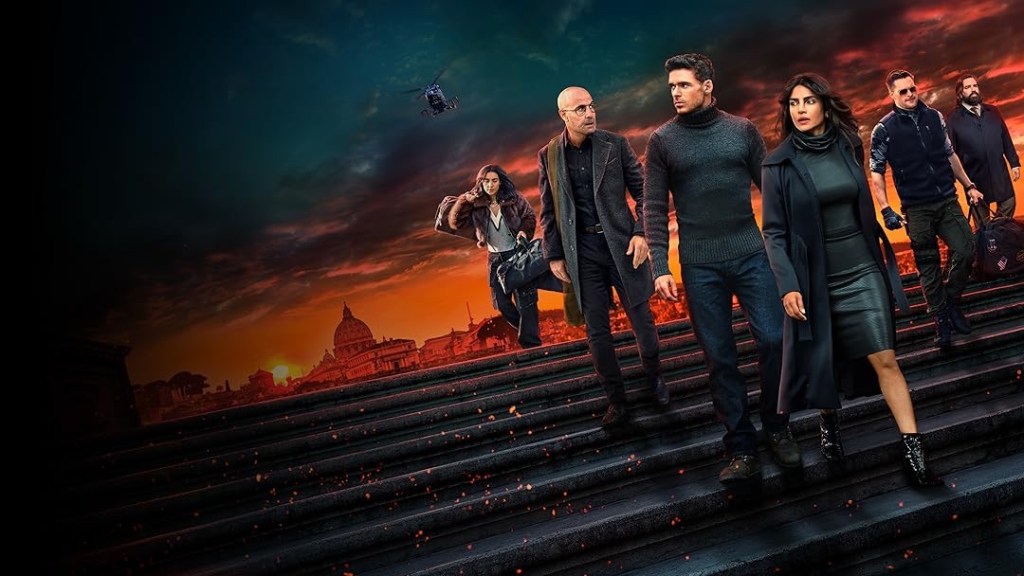
The global spy thriller universe of Citadel returns in Season 2 with higher stakes, deeper betrayals, and a much more ambitious story than its debut season. What began as a sleek espionage series about memory loss and secret agents has now evolved into a sprawling conspiracy thriller involving political assassinations, neural mind-control technology, fractured loyalties, and the possible collapse of global stability.
After the explosive finale of Season 1, the new season wastes little time throwing viewers back into chaos.
A World Still Haunted by Citadel’s Fall
Season 2 opens in the aftermath of Citadel’s destruction. The once-powerful independent spy agency remains shattered, its surviving operatives scattered across Europe while the shadow organization Manticore quietly rebuilds its influence.
At the center of the story are Mason Kane and Nadia Singh, two elite agents still trying to recover emotionally and psychologically from the betrayals uncovered in the previous season.
Mason regained his memories at the end of Season 1, only to discover that he himself played a role in Citadel’s collapse. Nadia, meanwhile, learned that she and Mason share a daughter, Asha, a revelation that complicates their already volatile relationship.
Trust becomes the defining theme of the season. Every alliance feels temporary. Every conversation carries suspicion.
The Rise of Paolo Braga
The biggest new threat comes in the form of Paolo Braga, a billionaire industrialist with deep ties to Manticore.
Braga is not simply another criminal mastermind. He represents a terrifying evolution in the show’s mythology: technology-driven control over human behavior.
His organization develops neural implants capable of transforming ordinary civilians into programmable assassins. The concept pushes Citadel further into science-fiction territory while maintaining the franchise’s grounded spy-thriller aesthetic.
This technology becomes the engine driving the season’s central conflict. If activated on a global scale, Braga’s system could destabilize governments, manipulate world leaders, and erase the distinction between free will and weaponized obedience.
Mason and Nadia: Broken Partners
One of Season 2’s strongest elements is the complicated relationship between Mason and Nadia.
Rather than presenting them as a polished super-spy couple, the season leans heavily into emotional damage and unresolved trauma.
Mason struggles with overwhelming guilt after learning how deeply he was manipulated before Citadel’s fall. Nadia questions whether she can ever truly trust him again. Their daughter becomes both a source of hope and a dangerous vulnerability.
The emotional tension gives the action sequences greater weight. Every mission feels personal because failure now threatens not just the world, but their family.
Bernard Orlick’s Secrets
Stanley Tucci’s Bernard Orlick becomes even more important in Season 2.
As one of the few surviving Citadel masterminds, Bernard works to rebuild the agency while recruiting former allies and unlikely partners. But the deeper the team investigates Manticore’s operations, the clearer it becomes that Bernard has been hiding dangerous truths about Citadel’s past.
The show smartly avoids simple “good versus evil” storytelling. Instead, it explores how intelligence organizations often survive through morally questionable decisions.
Even Citadel’s heroes carry blood on their hands.
Action Sequences on a Massive Scale
Season 2 dramatically expands the franchise’s action choreography and international scope.
Several sequences are already being highlighted as major set pieces:
The Swedish Supermarket Assault
One of the season’s signature moments features an extended firefight inside a Swedish supermarket, combining close-quarters combat, explosive tactical maneuvers, and large-scale destruction.
The Gala Infiltration
A lavish diplomatic gala becomes the setting for a tense espionage mission that spirals into disaster after a single dishonest decision compromises the operation.
The Scotland Safe House
What begins as a temporary refuge soon reveals horrifying truths about Braga’s experiments and the psychological cost of his technology.
The G8 Summit Finale
The season culminates at a high-security G8 summit where an assassination attempt and satellite takeover threaten to trigger worldwide chaos.
The scale feels noticeably larger than Season 1, with the show embracing a more cinematic blockbuster style.
A Smarter Tone This Time Around
One criticism of the first season was that it sometimes took itself too seriously while racing through complex mythology.
Season 2 appears more confident.
The writing reportedly embraces a faster pace, sharper humor, and a more self-aware tone. Instead of trying to imitate grounded espionage dramas exclusively, the show leans into pulpy spectacle, elaborate conspiracies, and high-concept spy fiction.
The result feels closer to a blend of:
- The Bourne Identity
- Mission: Impossible
- and modern comic-book thrillers
without completely losing its emotional core.
Expanding the Citadel Universe
Another fascinating aspect of Season 2 is how it strengthens connections to the broader Citadel universe.
The franchise has already expanded internationally through:
- Citadel: Diana
- Citadel: Honey Bunny
Season 2 reportedly plants narrative seeds that could tie all of these stories together into a larger interconnected espionage universe.
That ambition makes Citadel feel less like a single television series and more like a global franchise experiment.
Final Thoughts
Citadel Season 2 appears determined to improve on nearly every aspect of the first season:
- bigger action,
- stronger emotional conflict,
- more ambitious world-building,
- and a darker, more paranoid storyline.
At its core, however, the series remains focused on one central question:
What happens when the people trained to protect the world no longer know who they can trust, including themselves?
Whether the season fully delivers on its enormous ambitions remains to be seen, but one thing is clear: the world of Citadel has become far more dangerous than ever before.
 Shadows of Monte Cristo
Leave a comment