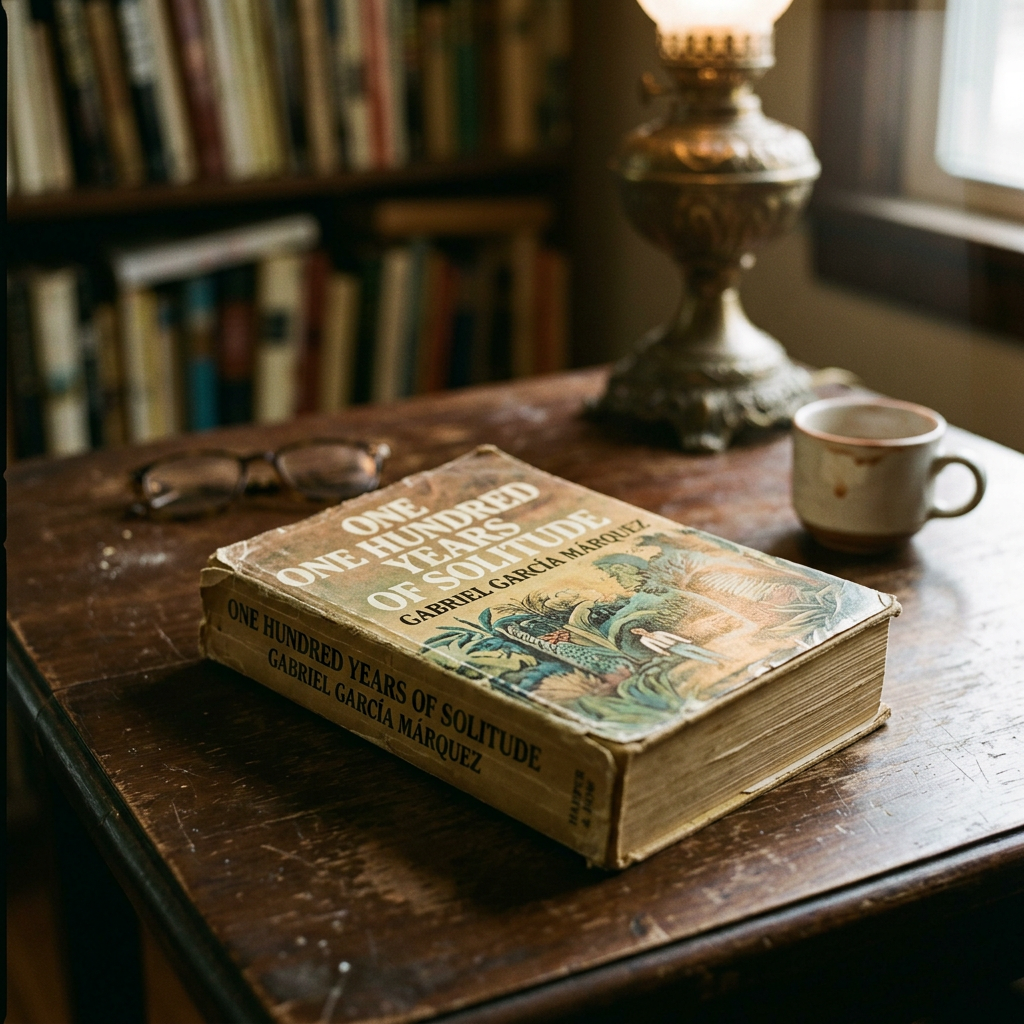


There are books you finish, place back on the shelf, and slowly forget. Then there are books you never actually finish, yet somehow they stay with you for years. For me, that book is One Hundred Years of Solitude by Gabriel García Márquez. I have started it more than once, and every time I find myself pulled into the strange, dreamlike world of Macondo and the long, complicated history of the Buendía family. Yet every time, somewhere along the way, I stop reading. Maybe it is the repeating names, the sprawling family history, or the unusual way time seems to move through the novel. Whatever the reason, I have never reached the final page, and somehow I still think about it.
Macondo is one of those fictional places that feels less like a setting and more like a memory you are not entirely sure belongs to you. At the beginning of the novel, José Arcadio Buendía and Úrsula Iguarán establish the town, creating what feels like an isolated world untouched by much of civilization. Slowly, the outside world begins to arrive. New inventions, political conflicts, changing technologies, and different generations reshape the town, but Macondo never entirely escapes its past. It is constantly changing while somehow repeating itself, and that contradiction is one of the things that stayed with me long after I stopped reading.
The Buendía family itself is part of what makes the novel both fascinating and difficult. Generations pass, but names return. There are multiple José Arcadios and multiple Aurelianos, and with those repeated names come repeated traits, mistakes, desires, and obsessions. At first, this was one of the most confusing parts of the book for me. I sometimes found myself wondering which character I was reading about or how one family member was connected to another. Over time, though, I began to wonder if that confusion was intentional. The Buendías do not simply inherit names. They seem to inherit patterns. One generation believes it is living a completely new life, only to repeat a version of what came before.
That repetition gives the novel a strange sense of destiny. Certain characters are drawn toward solitude, others toward passion, war, ambition, science, or obsession. The details change, but the emotional patterns often remain. It made me think about how families can repeat the same conflicts and behaviors without realizing it. It also made me think about how often people believe their experiences are completely unique when, in reality, they may be repeating something that began long before they were born.
One Hundred Years of Solitude is famous for its magical realism, where impossible or supernatural events are treated as ordinary parts of life. Ghosts appear, strange events happen without much explanation, and reality sometimes feels flexible. Surprisingly, though, the magical elements are not what stayed with me the most. What stayed with me was the loneliness. For such a large family, the Buendías often seem incredibly isolated from one another. They love each other, live together, fight with each other, and depend on each other, yet many of them remain trapped inside private worlds of grief, obsession, memory, or desire.
That loneliness makes the title feel especially powerful. The solitude in the book is not simply about being physically alone. It seems to pass from one generation to another. Characters can be surrounded by family and still feel emotionally separated from everyone around them. Some disappear into scientific experiments, others into politics or war, and others into relationships that never quite save them from themselves. Again and again, the characters seem unable to fully escape their own isolation.
Another part of the novel that stayed with me is its strange treatment of time. Most stories move forward in a relatively clear direction, but One Hundred Years of Solitude often feels circular. Names return, personalities return, wars return, mistakes return, and family history seems to repeat itself with slight changes. Eventually, it becomes difficult to tell where history ends and destiny begins. That idea fascinated me even when I found the book difficult to continue. It made me wonder how much of our lives is truly new and how much is shaped by patterns we inherit without realizing it.
I never stopped reading because I hated the book. In fact, I admired it. The problem was that admiration did not make it easy to read. The large cast of characters, repeated names, shifting generations, political history, surreal events, and unusual structure demanded more concentration than I was prepared to give it at the time. It became one of those books I kept promising myself I would return to. Then weeks passed, then months, and eventually the bookmark felt less like a placeholder and more like proof that I had quietly abandoned Macondo.
The strange part is that Macondo never completely left me. I have finished many books whose plots I can barely remember, yet fragments of One Hundred Years of Solitude continue to float through my mind. I remember the feeling of the town, the family names repeating across generations, the strange mixture of beauty and tragedy, and the sense that the Buendía family was constantly moving forward while being pulled backward by its own history. That feeling has stayed with me far longer than the details of many books I actually finished.
There is sometimes a strange guilt attached to not finishing a famous book. When a novel is considered a masterpiece, abandoning it can feel like admitting failure. I do not think that is always fair. Sometimes we encounter a book at the wrong moment. Maybe we are too distracted, too young, too busy, or simply not ready for the kind of attention the book requires. Sometimes we need to become a slightly different person before a certain book works for us. And sometimes, even without reaching the final page, a book still gives us something worth keeping.
That is what One Hundred Years of Solitude did for me. I may not have finished the entire story, but it still changed the way I think about family, memory, repetition, loneliness, and the strange ways the past can shape the present. I would like to return to it someday and see whether the book feels different now that I am different. Maybe the repeating names will seem less frustrating. Maybe the structure will make more sense. Maybe I will finally reach the last page. Or maybe I will stop again.
Either way, I think I am okay with that. One Hundred Years of Solitude has already earned a permanent place in my memory without ever earning a place on my list of books I have finished. Some books end when you reach the final page. Others stay with you even after you stop reading. For me, One Hundred Years of Solitude is one of those books.

Leave a Reply