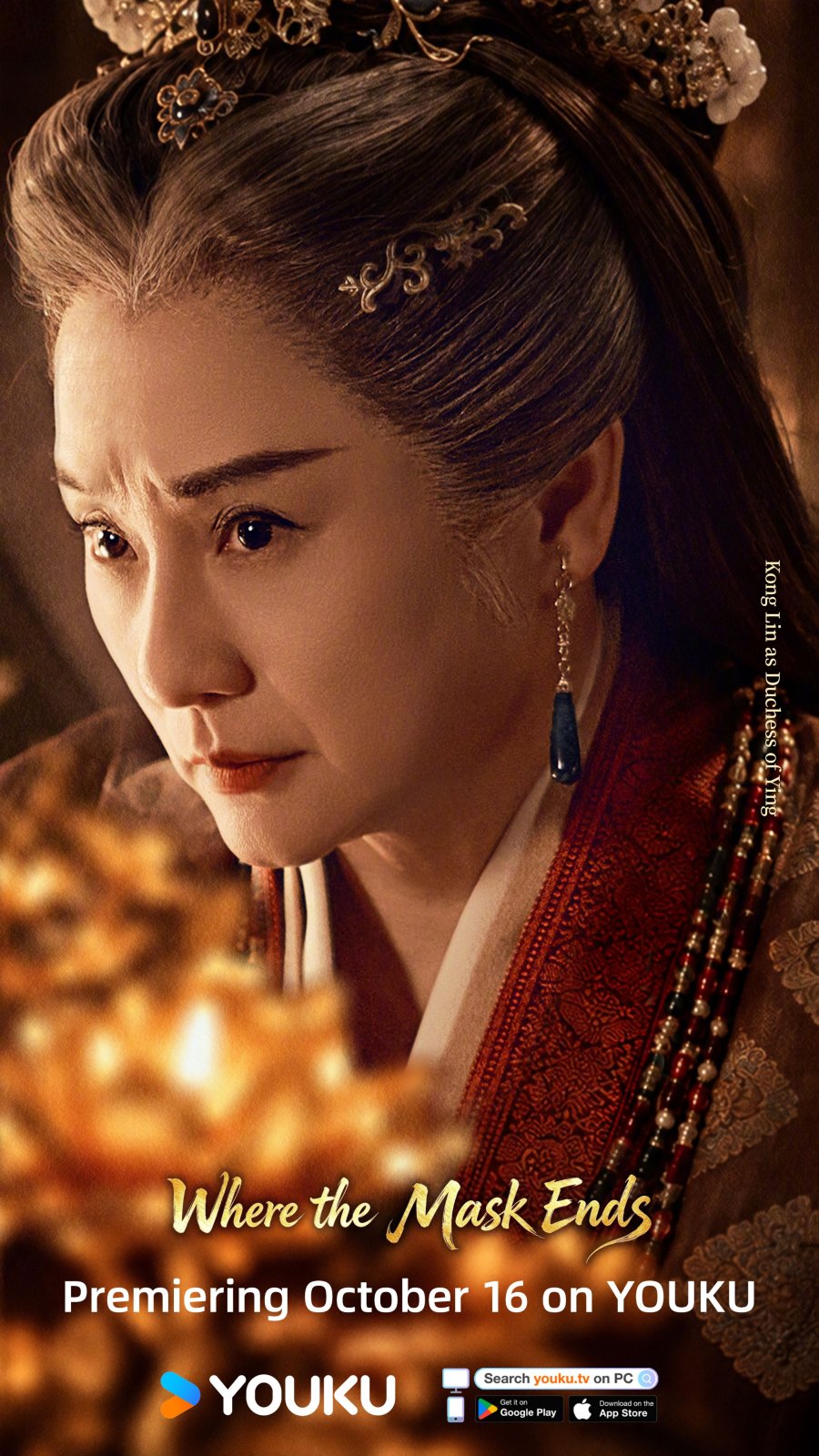
Episode 2 of Where the Mask Ends continues the shocking events of the premiere, shifting attention away from the privileged Wei Rao and introducing a young woman whose life could not be more different. While Wei Rao has spent her life surrounded by wealth, luxury, and relatives willing to protect her from the consequences of her actions, A-Chou has spent hers struggling to survive in poverty. Their worlds should never have crossed, but an extraordinary resemblance between the two women creates an opportunity for the Wei family to carry out its dangerous scheme. As preparations continue for Wei Rao’s unwanted marriage to the critically injured Lu Zhuo, the search for a substitute bride leads directly to A-Chou, a condemned prisoner whose desperate circumstances make her the perfect target.
The episode introduces A-Chou as a hardworking young woman living in extremely difficult circumstances. Unlike the noblewomen who spend their days attending banquets and preparing for prestigious marriages, A-Chou earns money through exhausting and unpleasant labor. She washes clothing, carries night soil, and accepts whatever work she can find to support her family. Her mother is ill, her younger brother and sister depend on her, and her father has become a serious burden because of his gambling. Although A-Chou works tirelessly, the money she earns is never enough to free her family from poverty. Her father’s irresponsibility repeatedly places them in danger, leaving A-Chou to shoulder responsibilities that should never have belonged to her alone.
Her already difficult life takes a devastating turn when her father becomes entangled in gambling debts that he cannot repay. Rather than accepting responsibility for his actions, he sells his daughter to a creditor, treating her as though she were property that could be exchanged to settle his obligations. A-Chou finds herself at the mercy of a man who has no concern for her safety or dignity. The situation becomes even more horrifying when he threatens to sell both A-Chou and her younger sister into a brothel. Realizing the danger facing them, A-Chou fights back. In the confrontation, she kills the man who threatens to destroy their lives.
Although her actions arise from a desperate attempt to protect herself and her sister, A-Chou has neither the money nor the social connections necessary to secure a fair hearing. She is arrested, convicted, and sentenced to death. Her circumstances demonstrate the enormous difference between the treatment of wealthy aristocrats and ordinary people. Wei Rao can commit violent acts and rely on her family’s influence to protect her reputation, while A-Chou faces execution after defending herself against a man who intended to exploit her family. This contrast establishes one of the episode’s most important themes: justice is often determined less by right and wrong than by wealth and social standing.
Meanwhile, Wei Heng’e continues searching for a woman who can impersonate her niece, Wei Rao. Since the Wei family cannot openly refuse the imperial marriage arrangement, she needs someone who resembles Wei Rao closely enough to deceive the powerful Lu household. Several candidates are presented, but none satisfies her requirements. Some look vaguely similar, while others are clearly unsuitable. Wei Heng’e becomes increasingly frustrated because the wedding deadline is approaching and there is little time to find someone capable of assuming Wei Rao’s identity.
The situation changes when Wei Heng’e notices a commotion involving prisoners being escorted through the street. Among them is A-Chou, whose appearance immediately captures her attention. Despite the young woman’s poor clothing, exhausted condition, and rough upbringing, her facial features are almost identical to those of Wei Rao. Wei Heng’e recognizes that she may have found the solution to her family’s problem. She orders one of her attendants to investigate A-Chou’s identity and the circumstances surrounding her arrest.
Once Wei Heng’e learns that A-Chou is condemned to death, she arranges for an agent to intervene. Rather than openly admitting that she wants to purchase a prisoner for an elaborate impersonation scheme, the agent claims that A-Chou is a runaway servant belonging to his household. By presenting the case as a dispute involving someone else’s property, he creates an opportunity for the authorities to release her into his custody. The magistrate, who already has reason to question the original judgment, offers little resistance. A-Chou is removed from the path to execution and secretly transported to the Earl of Cheng’an’s residence.
Although A-Chou has escaped an immediate death sentence, she quickly realizes that her rescue comes with conditions. Upon arriving at the Wei residence, she is instructed to wash and make herself presentable so Wei Heng’e can examine her more closely. Her resemblance to Wei Rao is extraordinary, and the possibility of replacing the noblewoman becomes increasingly realistic. However, A-Chou is not naive enough to believe that a powerful aristocratic family would rescue a poor condemned woman out of kindness. She understands that someone must want something significant from her.
The secret arrival does not go unnoticed. Guo Yufeng discovers that Wei Heng’e has brought an unfamiliar young woman into the residence and demands an explanation. When she learns about the plan to substitute A-Chou for Wei Rao, she immediately recognizes the danger. The Lu family is politically influential, and deceiving them could lead to disastrous consequences if the truth is exposed. Wei Heng’e argues that the circumstances make the deception possible. Lu Zhuo is gravely ill, several imperial physicians have already declared his condition hopeless, and few people outside the Wei household have seen Wei Rao because she has rarely appeared in public.
According to Wei Heng’e, the wedding only needs to proceed successfully. Once A-Chou becomes Lu Zhuo’s wife, the Wei family can manage the consequences while protecting the real Wei Rao. Wei Heng’e believes that Lu Zhuo is unlikely to survive and that the marriage will eventually leave the substitute bride a widow. In the meantime, the true Wei Rao can disappear temporarily and later resume her life under another identity.
Guo Yufeng remains uneasy, but her concerns take an unexpected turn when she sees A-Chou’s face. The resemblance is so remarkable that it appears to disturb her beyond the immediate risk of impersonation. Apart from A-Chou’s darker complexion and lack of aristocratic refinement, she could almost be mistaken for Wei Rao herself. Rather than treating this similarity as a fortunate coincidence, Guo Yufeng seems troubled by the possibility that it may have a deeper explanation.
Her reaction leads her to visit the quarters of Governess Chang, a woman connected to a disturbing secret from the past. Guo orders a search because A-Chou’s appearance has made her question whether certain instructions she gave years earlier were actually carried out. During the investigation, human remains are discovered. Governess Chang insists that she obeyed Guo’s old command and used scalding lime to destroy a body. Although the discovery appears to reassure Guo Yufeng that her secret remains buried, her anxiety suggests that something terrible happened long before the events of the present story. The episode does not reveal the complete truth, but the scene raises serious questions about A-Chou’s origins and whether her resemblance to Wei Rao is truly accidental.
While Guo Yufeng struggles with these suspicions, Wei Heng’e begins negotiating with A-Chou. She offers the young woman a life of comfort if she agrees to impersonate Wei Rao and marry Lu Zhuo. However, the opportunity comes with an unmistakable threat: if A-Chou refuses, she can be returned to the authorities to face execution. Wei Heng’e clearly expects the condemned woman to accept immediately and express gratitude for being spared.
A-Chou surprises her by refusing to be intimidated. She recognizes that the Wei family needs her just as desperately as she needs a way to survive. Rather than accept vague promises of wealth and comfort, she insists on negotiating concrete terms. She demands fifty thousand coins for her family’s support and asks to see her parents before agreeing to the arrangement. Wei Heng’e considers the price excessive, but A-Chou understands that her resemblance to Wei Rao makes her difficult to replace. With the wedding approaching and no other suitable candidate available, Wei Heng’e reluctantly agrees.
A-Chou’s demands reveal that her primary concern is not the possibility of becoming wealthy herself. She knows that entering the Lu household under a false identity could lead to imprisonment or death if she is discovered, and she has no reason to trust the people who have arranged the deception. What she wants is reassurance that her mother, younger brother, and sister will have enough money to survive after she leaves. The marriage may be dangerous, but it offers her an opportunity to provide for the people she loves.
When A-Chou is finally allowed to meet her parents, their reactions could not be more different. Her father is delighted by the money and the promise of an estate-management position. Rather than questioning why a wealthy family would suddenly offer such generous rewards, he becomes excited about his improved circumstances. His behavior reinforces the selfishness that has already caused so much suffering for his children.
A-Chou’s mother is far more suspicious. She recognizes that ordinary servant work would never justify such a large payment and understands that her daughter must be undertaking something dangerous. She urges A-Chou to reject the money rather than risk her life. Unable to reveal every detail of the impersonation scheme, A-Chou asks to speak with her mother privately. Their conversation becomes one of the episode’s most emotional moments as A-Chou prepares for a separation that may be permanent.
She urges her mother to take care of the younger children and warns her against placing too much trust in the Wei family’s promises. A-Chou makes it clear that her mother must focus on surviving rather than expecting her to return. Beneath her practical instructions is the painful understanding that the future she has agreed to may leave her unable to see her family again.
As the wedding approaches, the Wei family’s arrangements become increasingly elaborate. Five days later, A-Chou is dressed as Wei Rao and prepared to marry Lu Zhuo. The transformation is extraordinary. The poor young woman who previously washed laundry and carried night soil now wears the clothing and ornaments of a noble bride. Yet the luxurious garments cannot erase the danger surrounding her new identity. Every person she encounters must believe that she is the fourth daughter of the Wei family, and even the smallest mistake could expose the deception.
Lu Ya arrives to escort the bride on behalf of his injured brother. Since Lu Zhuo remains unconscious, he cannot participate in the wedding procession himself. However, the ceremony encounters an unexpected interruption when Lady Shou’an, Wei Rao’s maternal grandmother, appears. Furious over the marriage arrangement, she publicly accuses Wei Rao’s uncle of sacrificing his niece to strengthen relations with the Duke of Ying’s household.
Lady Shou’an’s anger reflects the concern that other members of Wei Rao’s family have already expressed. Lu Zhuo may be a respected military commander, but he is also believed to be dying. Sending a young woman into such a marriage could leave her widowed almost immediately. Old Madam Wei attempts to defend the decision by referring to the longstanding engagement and the hope that the marriage might bring Lu Zhuo good fortune. Nevertheless, Lady Shou’an refuses to treat the situation as an ordinary wedding.
The confrontation takes a surprising turn when Lady Shou’an announces that she has brought gifts for her granddaughter. An imperial decree recognizes Lu Zhuo’s military achievements and honors the bride’s willingness to marry him during his illness. The emperor grants the bride a magnificent golden crown, matching ornaments, and a crimson ceremonial robe, privileges normally associated with women of the imperial household. The gifts attract considerable attention and elevate the significance of the ceremony.
For A-Chou, the moment is almost overwhelming. She is being treated with extraordinary honor for a sacrifice that the real Wei Rao refused to make. Even more moving is Lady Shou’an’s genuine affection for the granddaughter she believes stands before her. The elderly woman wishes to see the bride’s face, but she is reminded that the ceremonial bridal fan should not be lowered until the proper moment. As a result, A-Chou avoids having her identity tested at a particularly dangerous point in the proceedings.
Lady Shou’an ultimately escorts the bride toward her carriage without realizing that the young woman beneath the elaborate bridal attire is a stranger. A-Chou is deeply affected by the grandmother’s kindness and privately resolves to repay it if she ever has the opportunity. For someone who has spent much of her life being mistreated or ignored, receiving such sincere affection creates a powerful emotional contrast.
Meanwhile, the real Wei Rao is far from pleased with the arrangement. Although she has successfully avoided the marriage she feared, seeing another woman receive her magnificent wedding gifts and imperial honors fills her with resentment. She cannot bear the thought of a poor stranger enjoying the privileges that she considers rightfully hers. Her jealousy exposes the contradiction at the center of her personality: she refuses to accept the responsibilities attached to her social position but still expects to retain all its rewards.
Wei Heng’e reassures her niece that A-Chou’s apparent good fortune will not last. In fact, she reveals an even more sinister plan. Once Lu Zhuo dies, the Wei family intends to arrange A-Chou’s death and present it as the suicide of a devoted widow who could not bear to live without her husband. Such a death would transform the substitute bride into a symbol of marital loyalty and bring public admiration to the Wei family.
The revelation makes it clear that A-Chou has not merely been hired to participate in a temporary deception. The people controlling the arrangement view her as disposable. They intend to use her to fulfill the imperial marriage order and then eliminate her before she can expose the truth. Wei Rao’s survival is being secured at the expense of another woman’s life.
To complete the deception, Wei Heng’e sends the real Wei Rao away to a secluded hot-spring residence. She informs her that she must abandon her original name because A-Chou will now be known publicly as Wei Rao. The real heiress receives the new name Jun Dai. Although she is unhappy about surrendering her identity, she accepts the arrangement because it allows her to escape the marriage.
Elsewhere, A-Chou’s family faces its own dangerous consequences. Her mother remembers her daughter’s warnings and realizes that remaining under the control of the Wei family’s servants may place the children at risk. During their journey away from the residence, she arranges for the escorts to stop and gives them tea containing a sedating ingredient from her medicine. Once the men lose consciousness, she escapes with A-Chou’s younger siblings, Hongxian and Runsheng.
Her husband, however, is left behind. When the escorts awaken and discover that the mother and children have escaped, they retaliate by strangling A-Chou’s father. They then prepare to conceal his body before reporting what happened. Although his behavior has repeatedly endangered the family, his death illustrates just how ruthless the Wei household’s agents can be when their orders are disrupted.
Back at the Duke of Ying’s residence, A-Chou finally arrives for her marriage to Lu Zhuo. She is welcomed by Kong Yingshu, Lu Zhuo’s fourth aunt, who explains that the usual wedding customs have been simplified because the groom remains critically ill. The atmosphere is entirely different from the joyful celebrations normally associated with a noble marriage. Lu Zhuo lies unconscious, and the household is hoping that the bride’s presence will somehow help save his life.
During the preparations, Kong Yingshu notices that A-Chou is wearing gloves despite the warm weather. The observation threatens to reveal the difference between A-Chou and the woman she is impersonating. Years of difficult physical labor have left marks on her hands that would be unusual for a sheltered noblewoman. Thinking quickly, A-Chou explains that she injured her hands while doing needlework for the wedding and feels embarrassed about their appearance. Her explanation is accepted, allowing her to avoid suspicion for the moment.
Once the ceremonies are completed, A-Chou is brought into the bridal chamber, where Lu Zhuo remains unconscious. The sight of her new husband creates a strange and unsettling moment. She has married a man she does not know, taken the identity of a woman she has barely encountered, and entered a household where discovery could mean her death. She reflects on the extraordinary change in her circumstances: a poor woman who once performed the most unpleasant work imaginable is now the wife of a powerful noble heir.
Despite the deception surrounding their marriage, A-Chou does not treat Lu Zhuo with cruelty. She carefully helps reposition him so that he can rest more comfortably before lying down beside him. His condition remains serious, and she has no reason to expect that he will awaken during the night.
Then the impossible happens.
Lu Zhuo opens his eyes.
Rather than greeting his bride with gratitude or confusion, he reacts with immediate anger. Seeing the woman he believes to be Wei Rao lying beside him, he orders her to leave his bed. A-Chou is stunned by his hostility. She knows that she is impersonating his fiancée, but she does not understand the bitter history between Lu Zhuo and the real Wei Rao. From her perspective, his reaction seems almost inexplicable.
Realizing that Lu Zhuo has awakened, A-Chou quickly calls for help. His relatives rush into the chamber, overwhelmed by the possibility that he has survived an injury everyone believed would kill him. A physician examines him and confirms that his condition has stabilized. Although the poison remains in his body and he will require careful treatment, his life is no longer in immediate danger.
The Lu family is overjoyed. After spending days fearing the worst, they finally have reason to hope for his recovery. His grandmother becomes convinced that the marriage has brought the good fortune the family prayed for. She warmly thanks A-Chou, believing that she is Wei Rao and that she willingly entered the marriage despite knowing her fiancé might die.
Other relatives express similar gratitude and assure the bride that the family will remember her devotion. A-Chou responds modestly and attributes Lu Zhuo’s recovery to divine protection rather than claiming credit for it herself. She encourages the exhausted relatives to rest and offers to continue caring for her husband under the guidance of Governess Miao.
However, the celebration hides a serious new problem. The entire deception was built around the expectation that Lu Zhuo would die. With his recovery now possible, A-Chou faces the terrifying prospect of living indefinitely as Wei Rao. She must convince a sharp-eyed military commander that she is the woman he has known since childhood, even though he already despises his original fiancée.
The episode ends with the relatives leaving the newlyweds together, believing that the marriage has saved Lu Zhuo’s life. A-Chou, meanwhile, is left facing the man whose survival has completely changed her future. His cold and hostile expression makes one thing painfully obvious: escaping the Wei family’s plans will not be easy.
Leave a Reply